 American Coast Guardsman Charles Tyner, who was slightely wounded in the head during the invasion of Southern France on 15 August 1944, when a piece of shrapnel pierced his helmet.
In times of war, soldiers are usually killed or wounded by explosive devices (shells, mines, grenades, etc...) or bullets. In most environments, the majority of the body surface of a soldier is covered by his uniform, helmet, equipment and personal items. Typically, only the face and hands are left uncovered. If a soldier is hit, the projectile will thus usually go through various items being worn by the soldier before reaching the soldiers skin and causing a wound: a record of the projectile is thus preserved by the material items on the soldier. Usually this material item will be the uniform, or other large items such as helmets. Sometimes though, the wounding agent may strike a surprisingly small or symbolic object on the soldier. The damaged items can sometimes be used to establish the cause of death of a long lost soldier, in cases where no other trace of the wound is present.
The goal of this small website is to present various battle damaged items recovered from World War 2 battlefields, and to show the large variety of types of damage that can occur on a large variety of objects. There will also be some basic explanations about the ballistics of bullets and shrapnel, and the effects they have on their target.
Contact: The author of this website can be contacted at the following address: jean-loup@gassend.com

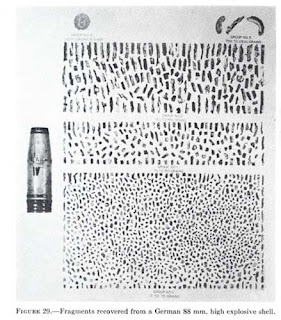 1-Contrary to popular belief, most casualties of WW2 and other modern wars are hit by shrapnel fragments, not by bullets. Shrapnel fragments are all the debris that are set into motion by an explosion, and that can travel at extremely high speed and cause horrific wounds, even dozens or hundreds of meters away from the explosion. Most of the shrapnel fragments are actually pieces of what ever caused the explosion: shell, grenade, etc. However, the shrapnel can also be simple parts of the local environment: stones, earth, bricks, broken glass or wood, etc... Some shells contain hundreds of little balls, and grenades often have many grooves on their surface, to make sure that more deadly shrapnel is produced. The photo above shows an 88 milimetre German shell on the left; and the shrapnel that is produced when one single such shell explodes, on the right. A person near the epicentre of such an explosion can be expected to be hit by dozens or hundreds of pieces of shrapnel. A person located further away will be hit by fewer, or only a single piece of shrapnel. But one piece can be enough to kill a person on the spot. (Photo credit: 'Wound Ballistics' by Leonard D. Heaton http://history.amedd.army.mil/booksdocs/wwii/woundblstcs/default.htm )
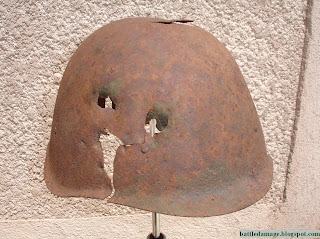 2-This Russian helmet recovered on a battlefield of the region of Demjansk, Russia, has been hit by multiple intermediate sized pieces of shrapnel. The helmet was probably located within a few meters of a shell explosion. Approximately 30% of war dead are killed by head wounds. The fate of the owner of this helmet is unknown.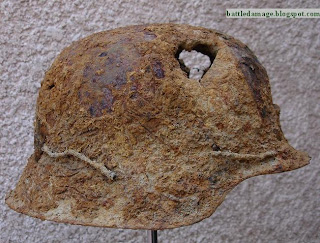
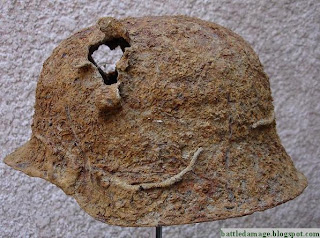 3 a-This German helmet has been hit by two pieces of shrapnel. One very small piece hit near the back of the helmet, making an entrance hole, but not exiting the helmet. The second larger fragment went right through both the helmet and the wearers head, clearly illustrating the deadly effects a single fragment of shrapnel can have. This helmet was discovered in a mass grave in France along with the body of its owner, who had been left buried on the battlefield. The owners skull had similar damage to the helmet. When the soldiers body was identified and his family located, a photo of this helmet was sent to his family along with an explanation that their loved one had died immediately and not suffered. The family greatly appreciated this detail. The presence of two shrapnel holes indicated the soldier was probably within a few meters from the explosion.
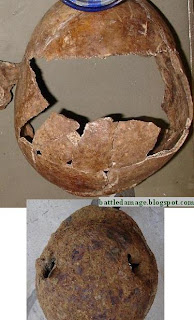 3 b-Superior view of the same helmet next to the skull of the owner, showing the matching damage.
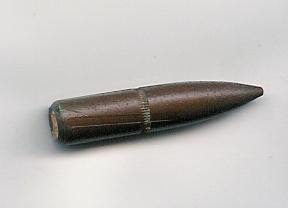 4-This rifle bullet was fired, but probably in the air, as it was found undamaged on a battlefield. Bullets are fired point first to make them as aerodynamical as possible, so that they will travel further. However, the pointed end of a bullet is also its lightest end. Objects have a natural tendency to want to travel with their heavy end first; not their light end first, because the heavy end has a greater mass surface ratio, making it less subject to drag. Thus, a bullet is naturally unstable, wanting to flip around and travel heavy end first. To counter this effect, guns have spiralling grooves inside their barrels to make the bullets spin on their long axis as they travel through the atmosphere. The spinning causes the bullet to be stabilised by gyroscopical effect (the same effect that keeps a top stable and standing until it stops spinning). The groves inside the barrel of the weapon leave corresponding lines imprinted on the bullet, visible in the photo above. The number and thickness of the imprint left on the bullet can indicate the model of weapon the bullet was fired from. If the imprint is examined with a microscope, it may be possible to determine the exact weapon it was fired from, if the weapon is available for comparison.
Rifle bullets travel at much greater speeds (around 750 meters per second) then pistol bullets (around 400m/s), so are subject to more friction with the air, and thus have a tendency to be less stable. To compensate for this, rifle bullets are made longer and thinner: this shape is more stable then the short and stubby shape of pistol bullets.

6-This highly symbolic German identification tag was found with the body of a killed soldier in France. The soldier was killed by a .30 cal bullet that pierced the very tag that would enable his identification more then 60 years after his death. The bullet hole is perfectly centred, as if it had been aimed that way by a shooter with a sense of irony. In fact it is probably by pure chance that the bullet happened to strike the middle of the identification tag, that would have been hidden from view under the soldiers uniform at the time of wounding. People have a tendency to romantacize warfare, and this type of damage is often wrongly attributed to expert sniper fire. A video of this tag being discovered is available here: http://www.youtube.com/watch?v=343cin_nQHU

7-This Italian paratrooper helmet was recovered on a battlefield in North Africa, where it was probably used by a member of the famous Folgore division, that suffered very heavy loses at the battle of El Alamein. The helmet clearly illustrates the killing power possessed by bullets: a rifle bullet struck the back of the helmet at an angle, but effortlessly penetrated the helmet and exited out of the front. The fate of the owner is unknown.
 9-These two British coins were found on a battlefield in North Africa. Both coins have been subject to very violent treatment, causing the shapes of other coins to become imprinted on them. The exact cause is unknown in this case, but this effect is to be expected when a full wallet is hit by a bullet or shrapnel fragment, or is involved in a violent plane crash.
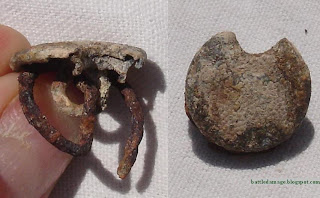 10-Even the smallest and most modest items being worn by a soldier can be damaged when the soldier is hit. This bullet damaged button was found with the body of a killed German soldier.
 11-This German army belt buckle has been pierced by multiple small pieces of shrapnel, damaging the infamous inscription 'Gott mit Uns' (good with us). It was found in a bunker on the battlefields of Demjansk, Russia. The fate of its original owner is unknown.
 12-This American identification tag (commonly refered to as a 'dog tag') was sent back to the family of John A. Patten after he was killed in action in Germany on April 19th 1945. The tag has been pierced by multiple small shrapnel fragments, indicating that John Patten was probably killed by an explosive device that detonated within a meter or two of him. 'Museum of the Soldier' Collection, Indiana, USA.
 13-This wallet was sent back to the family of a Polish soldier who was mortaly wounded in France as a member of the German army in 1944. The wallet has been pierced by a piece of shrapnel, that also damaged several pictures that were contained within the wallet. Shown here is a photo of the soldier's wife and two young children, the bottom of the photo is torn by the projectile that killed their husband and father.
 14-This British military paybook belonged to soldier Thomas Mills, of the Royal Welch Fusiliers, who was severely wounded in action in Normandy on July 16th 1944, loosing his left leg. The paybook has been hit and damaged by multiple small fragments typical of an explosion occuring at close range. (Private Collection)
Weighty memento: war veteran's secret revealed after his death. Cremation reveals WWII veteran's shrapnel in leg... or NOT

In October 2012, a large number of major media outlets published the touching story of Ronald Brown, a World War II veteran of the East Yorkshire Regiment, who had recently passed away. According to the various articles, it was known to Mr Brown's relatives that he had a bullet embedded in his knee, and his relatives therefore asked the crematorium staff to try to find the bullet amongst his ashes. Instead, they were surprised to be handed 6 ounces of 'shrapnel' fragments that, they thought, Mr Brown had carried in his body since 1944. This is the story that was repeated in the press, with pictures like the ones visible here.
It is however unfortunately painfully obvious, that what is shown here does not look anything like shrapnel fragments, because what is shown are in fact screws and staples from one or severeral cremated coffins that remained in the crematorium oven after the cremation! Perhaps there are one or two actual shrapnel fragments hidden in the pile, but they are not visible. It is very shocking that such a blatantly wrong story was repeated without question by numerous major media sources, and it is a very worrying state of affairs when the international press spreads such disinformation without any question!
Regardless of this misunderstanding, we thank Mr Ronald Brown for his World War II service, and excuse ourselves to his relatives for bringing this disappointing news to them.


Robert J. Carey, shown holding his Army identity "dog tags" with a bullet hole through them. He was wearing them on a chain around his neck during a live-fire training exercise in which a machine gunner fired too low at Carey's unit. Five men were killed. A bullet grazed Carey's chest, passing through his dog tags. Age 88 | Hometown: Portland | Private first class, 82nd Airborne | Army | Europe
battle damaged military items mortuary affairs quartermaster corps shrapnel helmet wallet bullet investigation fragmentation wehrmacht villeneuve-loubet stalingrad burcy terminal balistics graves registration erkennungsmarke plaque identité fouille détection éclat obus balle
